A novel
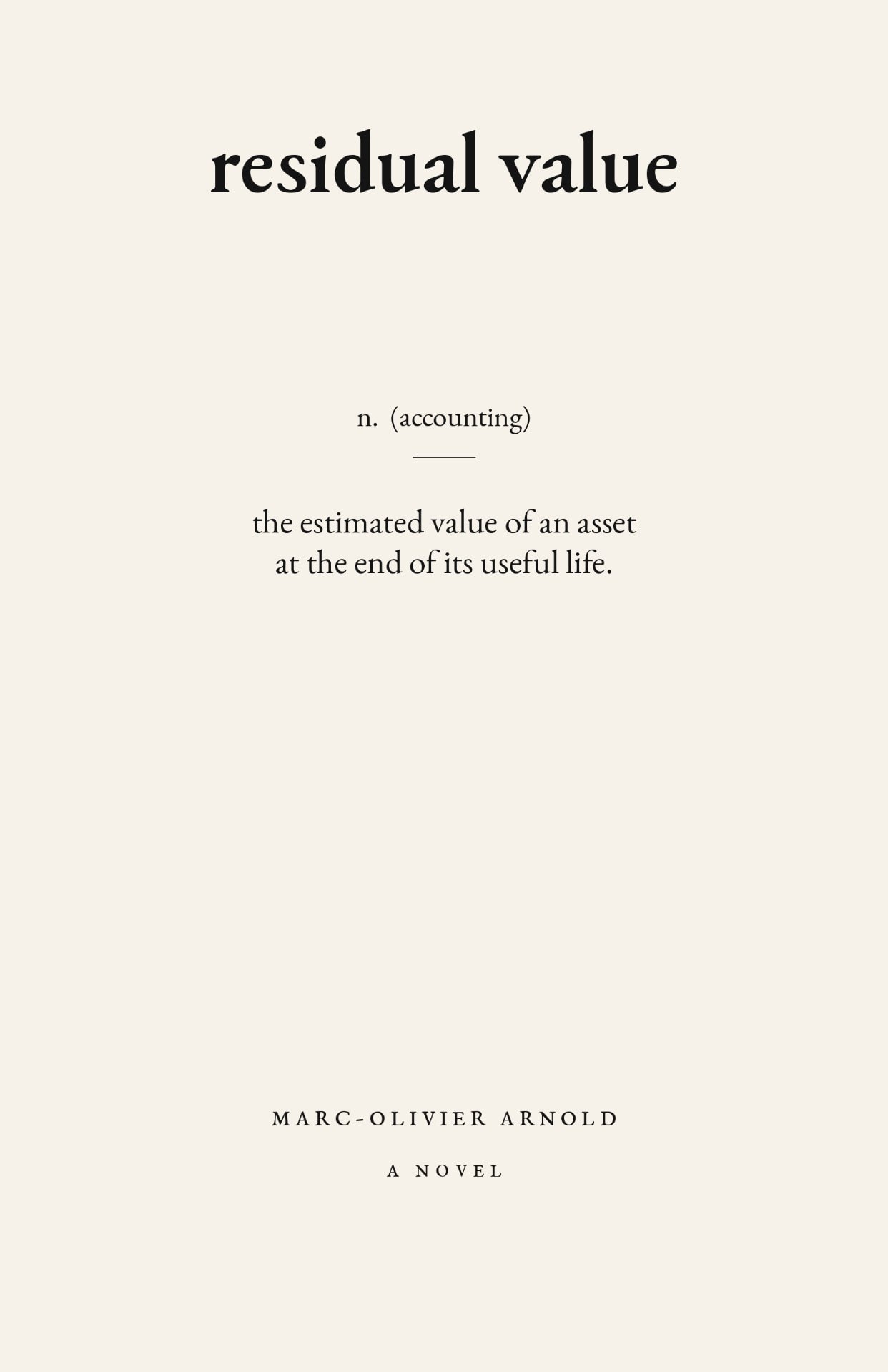
residual value
What should remain difficult?
A novel of Paris, Shanghai, and forty-three new stores.
Marc-Olivier Arnold
The Novel
Julien is forty-five, and for twenty years he has been paid to make people want things. He is very good at it. He has a firm, a partner, an apartment in Paris, a life in Shanghai, a wife who runs both with more precision than he runs his company, and Nina, who belongs to neither.
Then a client asks him a question he can’t bill his way out of. Claire’s company plans to open forty-three stores, and she wants to know how to do it without becoming ordinary. In other words: what should remain difficult?
Over the following year, between Paris, Shanghai, a porcelain town nobody has heard of and a municipal tennis court, Julien discovers that the difficulty in his life was being supplied by other people: a partner who stayed, a company that waited, sons who asked permission, a woman who answered late. One by one, they stop.
At forty-five, he also decides to win a single ATP point. It has no practical value. It is the first thing in years that refuses to be easy.
Julien is used to managing desire for other people. His own proves less cooperative.
He has spent twenty years making people want things. He is less successful at keeping them.
A few questions
- What happens?
Julien is forty-five. He advises luxury companies on how to make people want things, and has made a good living doing it. Then a client asks how to open forty-three new stores without becoming ordinary. Meanwhile, his consulting firm is changing, his family is becoming less predictable, and the people around him seem increasingly capable of making decisions without him.
He also decides to pursue a single ATP ranking point. Nobody has asked him to do this.
- Is it a novel about luxury?
Yes, although not only. Luxury is an industry devoted to making things people don’t need feel absolutely necessary. It employs some very intelligent people, spends extraordinary amounts of money and produces genuinely beautiful things. It also has a remarkable ability to take itself seriously.
- Is it autobiographical?
No. The author has spent more than twenty years working with luxury companies, so he knows the meetings, the hotels, the people and the strange conversations that take place behind the finished image.
The characters are fictional. Some of the situations are less invented than one might expect.
- Why Residual Value?
It’s an accounting term: the estimated value of something at the end of its useful life. Companies calculate it for cars, machinery and buildings.
People generally prefer not to think about it. Particularly around forty-five.
Julien has spent his career helping companies understand what makes them valuable. He’s beginning to have less certainty about his own answer.
- Is it funny?
At times. Luxury provides quite a lot of material without anyone having to invent very much. Julien contributes his share, usually without intending to.
- Is it a pessimistic novel?
Not particularly. People eat well, travel, make money, fall in love, have sex, raise children and occasionally behave rather badly. Some are perfectly happy.
Things simply don’t always work out as they expected.
- Is there tennis?
Yes. Julien takes it increasingly seriously, despite his body offering several reasons not to.
There are easier ways to spend middle age. Most of them interest him less.
- Who is it for?
People interested in luxury, certainly. But also anyone who has built a successful life and occasionally wondered why it doesn’t feel quite the way they imagined.
Or who has wanted something, obtained it, and then found themselves wanting something else.
Read the first pages
Plain-text version
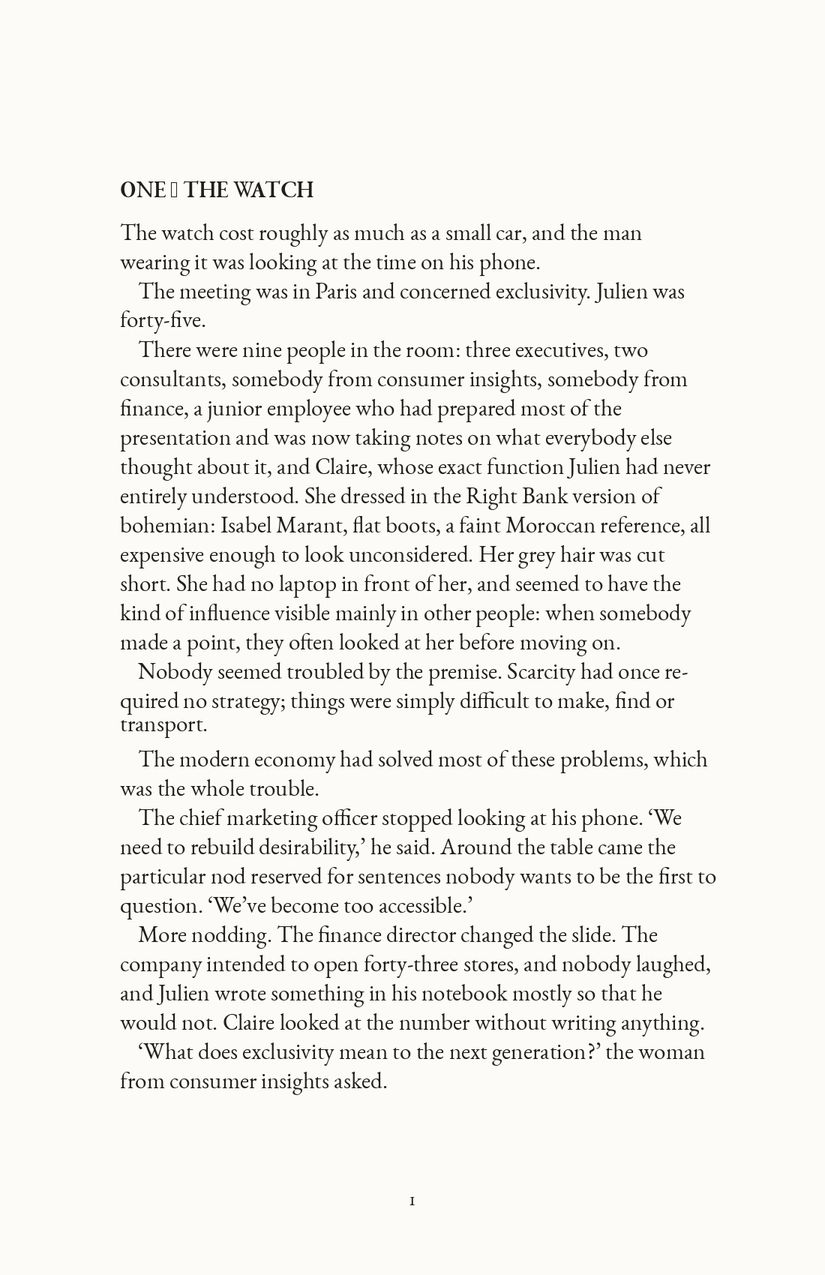
ONE — THE WATCH
The watch cost roughly as much as a small car, and the man wearing it was looking at the time on his phone.
The meeting was in Paris and concerned exclusivity. Julien was forty-five.
There were nine people in the room: three executives, two consultants, somebody from consumer insights, somebody from finance, a junior employee who had prepared most of the presentation and was now taking notes on what everybody else thought about it, and Claire, whose exact function Julien had never entirely understood. She dressed in the Right Bank version of bohemian: Isabel Marant, flat boots, a faint Moroccan reference, all expensive enough to look unconsidered. Her grey hair was cut short. She had no laptop in front of her, and seemed to have the kind of influence visible mainly in other people: when somebody made a point, they often looked at her before moving on.
Nobody seemed troubled by the premise. Scarcity had once required no strategy; things were simply difficult to make, find or transport.
The modern economy had solved most of these problems, which was the whole trouble.
The chief marketing officer stopped looking at his phone. ‘We need to rebuild desirability,’ he said. Around the table came the particular nod reserved for sentences nobody wants to be the first to question. ‘We’ve become too accessible.’
More nodding. The finance director changed the slide. The company intended to open forty-three stores, and nobody laughed, and Julien wrote something in his notebook mostly so that he would not. Claire looked at the number without writing anything.
‘What does exclusivity mean to the next generation?’ the woman from consumer insights asked.
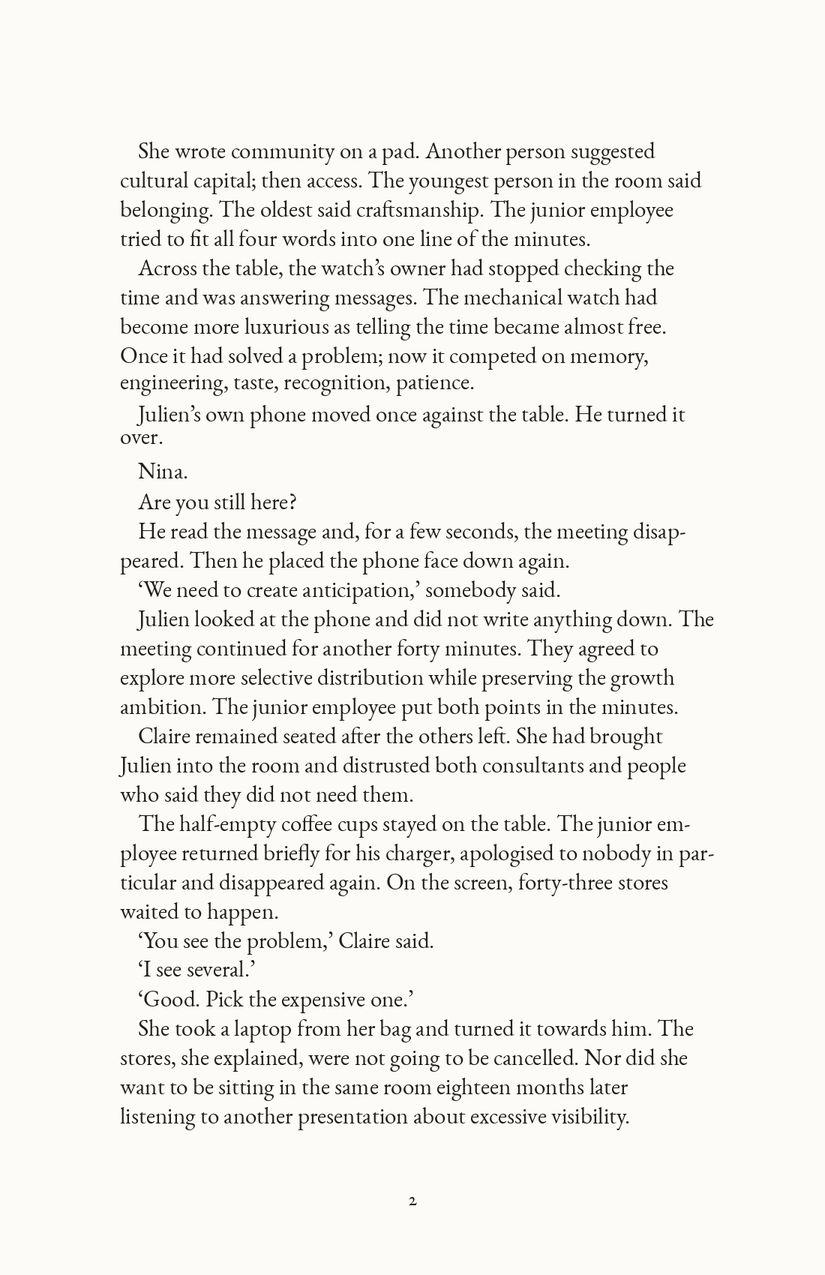
She wrote community on a pad. Another person suggested cultural capital; then access. The youngest person in the room said belonging. The oldest said craftsmanship. The junior employee tried to fit all four words into one line of the minutes.
Across the table, the watch’s owner had stopped checking the time and was answering messages. The mechanical watch had become more luxurious as telling the time became almost free. Once it had solved a problem; now it competed on memory, engineering, taste, recognition, patience.
Julien’s own phone moved once against the table. He turned it over.
Nina.
Are you still here?
He read the message and, for a few seconds, the meeting disappeared. Then he placed the phone face down again.
‘We need to create anticipation,’ somebody said.
Julien looked at the phone and did not write anything down. The meeting continued for another forty minutes. They agreed to explore more selective distribution while preserving the growth ambition. The junior employee put both points in the minutes.
Claire remained seated after the others left. She had brought Julien into the room and distrusted both consultants and people who said they did not need them.
The half-empty coffee cups stayed on the table. The junior employee returned briefly for his charger, apologised to nobody in particular and disappeared again. On the screen, forty-three stores waited to happen.
‘You see the problem,’ Claire said.
‘I see several.’
‘Good. Pick the expensive one.’
She took a laptop from her bag and turned it towards him. The stores, she explained, were not going to be cancelled. Nor did she want to be sitting in the same room eighteen months later listening to another presentation about excessive visibility.
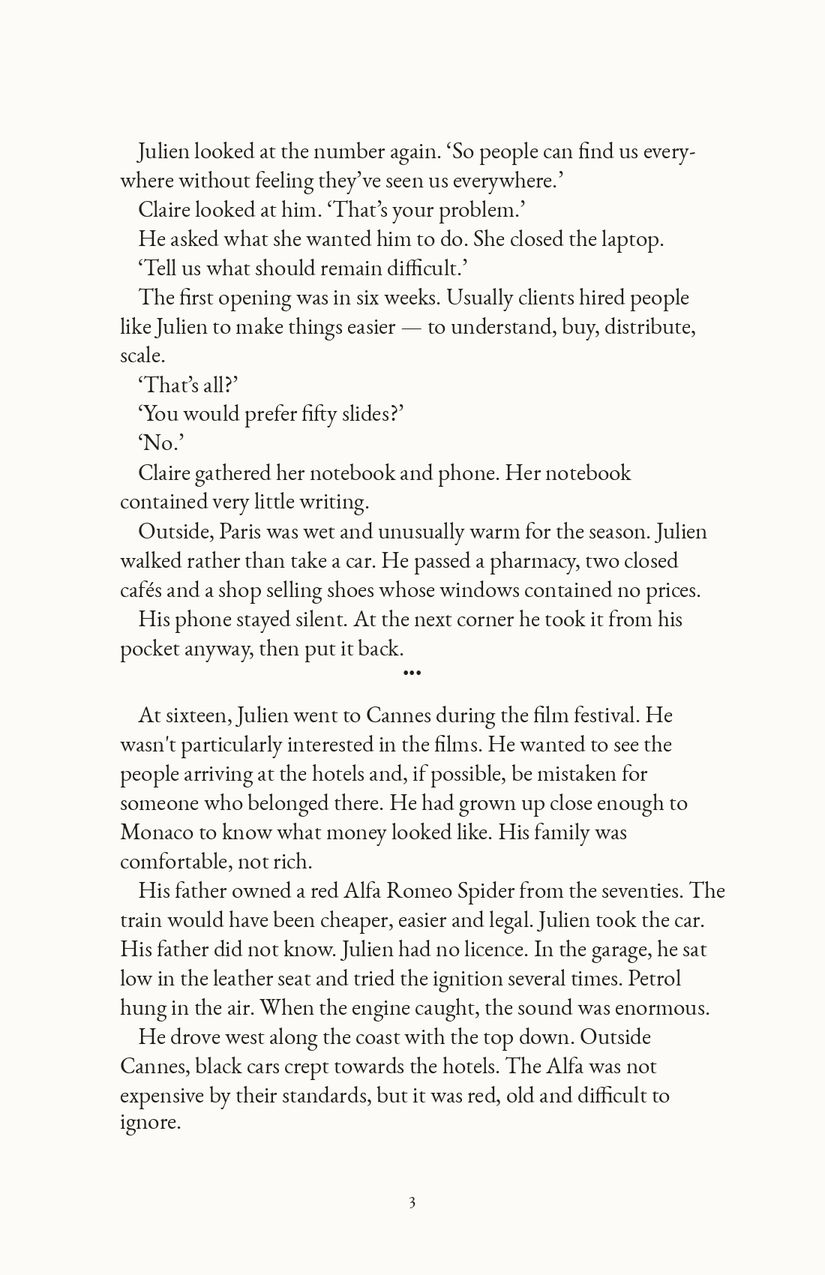
Julien looked at the number again. ‘So people can find us everywhere without feeling they’ve seen us everywhere.’
Claire looked at him. ‘That’s your problem.’
He asked what she wanted him to do. She closed the laptop.
‘Tell us what should remain difficult.’
The first opening was in six weeks. Usually clients hired people like Julien to make things easier — to understand, buy, distribute, scale.
‘That’s all?’
‘You would prefer fifty slides?’
‘No.’
Claire gathered her notebook and phone. Her notebook contained very little writing.
Outside, Paris was wet and unusually warm for the season. Julien walked rather than take a car. He passed a pharmacy, two closed cafés and a shop selling shoes whose windows contained no prices.
His phone stayed silent. At the next corner he took it from his pocket anyway, then put it back.
•••
At sixteen, Julien went to Cannes during the film festival. He wasn't particularly interested in the films. He wanted to see the people arriving at the hotels and, if possible, be mistaken for someone who belonged there. He had grown up close enough to Monaco to know what money looked like. His family was comfortable, not rich.
His father owned a red Alfa Romeo Spider from the seventies. The train would have been cheaper, easier and legal. Julien took the car. His father did not know. Julien had no licence. In the garage, he sat low in the leather seat and tried the ignition several times. Petrol hung in the air. When the engine caught, the sound was enormous.
He drove west along the coast with the top down. Outside Cannes, black cars crept towards the hotels. The Alfa was not expensive by their standards, but it was red, old and difficult to ignore.
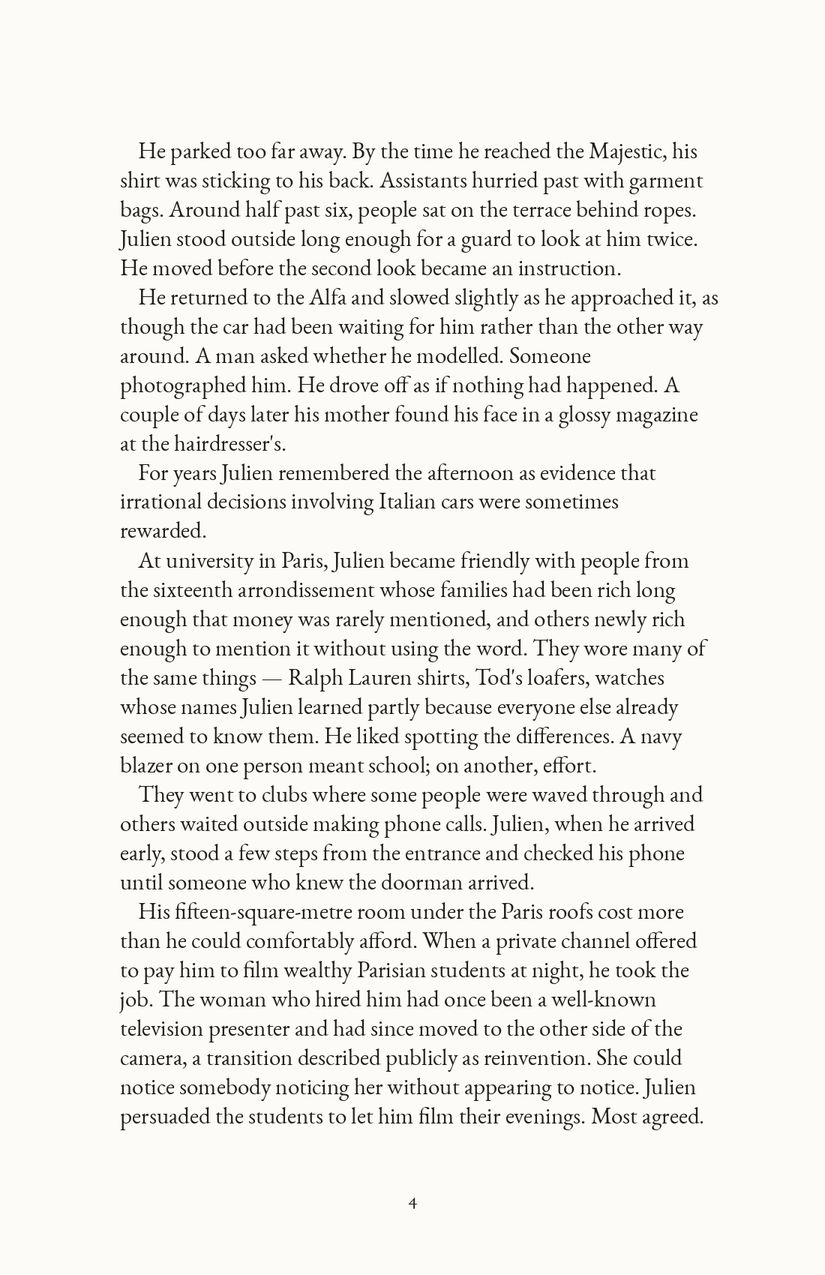
He parked too far away. By the time he reached the Majestic, his shirt was sticking to his back. Assistants hurried past with garment bags. Around half past six, people sat on the terrace behind ropes. Julien stood outside long enough for a guard to look at him twice. He moved before the second look became an instruction.
He returned to the Alfa and slowed slightly as he approached it, as though the car had been waiting for him rather than the other way around. A man asked whether he modelled. Someone photographed him. He drove off as if nothing had happened. A couple of days later his mother found his face in a glossy magazine at the hairdresser's.
For years Julien remembered the afternoon as evidence that irrational decisions involving Italian cars were sometimes rewarded.
At university in Paris, Julien became friendly with people from the sixteenth arrondissement whose families had been rich long enough that money was rarely mentioned, and others newly rich enough to mention it without using the word. They wore many of the same things — Ralph Lauren shirts, Tod's loafers, watches whose names Julien learned partly because everyone else already seemed to know them. He liked spotting the differences. A navy blazer on one person meant school; on another, effort.
They went to clubs where some people were waved through and others waited outside making phone calls. Julien, when he arrived early, stood a few steps from the entrance and checked his phone until someone who knew the doorman arrived.
His fifteen-square-metre room under the Paris roofs cost more than he could comfortably afford. When a private channel offered to pay him to film wealthy Parisian students at night, he took the job. The woman who hired him had once been a well-known television presenter and had since moved to the other side of the camera, a transition described publicly as reinvention. She could notice somebody noticing her without appearing to notice. Julien persuaded the students to let him film their evenings. Most agreed.

The Author

Marc-Olivier Arnold
Marc-Olivier Arnold has spent twenty-five years working with luxury companies, mostly between China and Europe. He is co-founder and partner at Other Logic Partners and was named to the Jing Daily 100, which recognises people shaping the luxury industry in China.
Residual Value is his first novel.
On writing the book
For more than twenty years, I’ve sat in rooms where people discussed how to make other people want things. Some of those conversations were fascinating. Others were quite ridiculous. I was usually taking part.
Over time, I realised that what interested me most wasn’t necessarily the luxury itself. It was the people around it. Their ambition, their insecurities, the things they were prepared to do to succeed, and sometimes the extraordinary amount of effort involved in making something look effortless.
That’s partly why I started writing Residual Value.
The characters are invented, although some of the situations are not entirely unfamiliar. And somewhere along the way, I realised I had probably put more of myself into Julien than I originally intended.
Publication
Coming soon.
Paperback and ebook editions are planned for Amazon.
Advance reading copies & press enquiries: residualvalue.book@gmail.com